

A nest beside a front door, a loft hatch, or a patio table needs professional assessment before anyone goes near it. Most people who look for wasp nest removal in Essex providers can help with having noticed wasps coming and going from the same spot.
Late summer is when the question usually becomes urgent, because a nest has had months to grow, and its workers are drawn to sugary food and drink outdoors.
Why Professional Wasp Nest Treatment May Be Necessary
One wasp on a jam sandwich is not a nest problem. Foraging wasps can travel some distance, so a busy barbecue does not prove there is a nest on your property.
A genuine concern is a nest near an entrance, a classroom door, a pub garden, or a bedroom window. Isolated nests, such as one in an unused garden shed, can sometimes be left alone.
Wasps also pollinate and eat other insects, but bees need different handling.
Signs of an Active Wasp Nest Around Your Property
Watch the flight paths. Wasps heading repeatedly to one gap under the eaves or an airbrick, rather than passing by, are almost certainly using that opening as a nest entrance.
- Steady, increasing traffic in and out of one opening
- Papery grey material visible in a sheltered spot, such as a shed corner
- Wasps vanishing into a small hole in a bank or lawn, which can signal an underground nest
Observe from a safe distance and stay away from the suspected opening.
Why DIY Wasp Nest Removal Can Be Risky
Killing the wasps you can see does very little to an established wasp colony. Household sprays tend to catch individual insects without reaching the nest or the developing wasps inside it.
Blocking the entrance or knocking the nest down is worse. Disturbed wasps are likely to defend the nest, and with the entrance sealed, they may look for another way out, sometimes into the house.
BPCA’s wasp guidance points people with a troublesome nest towards a trained professional rather than DIY methods.
Anyone with a known sting allergy should keep well away from a nest. Suspected anaphylaxis means calling 999 immediately.
How Professional Wasp Nest Treatment Works
A technician starts by confirming where the activity is coming from. They then look at where the nest sits, how it can be reached, and who or what is nearby.
The treatment is chosen from there. Depending on the nest, that may mean an insecticidal dust or another suitable formulation applied at the nest or a safe access point under the product’s approved instructions.
Where the method relies on it, returning workers carry the product into the nest, so the technician allows time for that to happen.
A nest under open eaves can be assessed quickly, while one in a cavity wall, loft, garage, or tree may take far longer to locate and reach. The visible hole is not necessarily where the nest is or how big it is.
Does a Wasp Nest Need to Be Physically Removed?
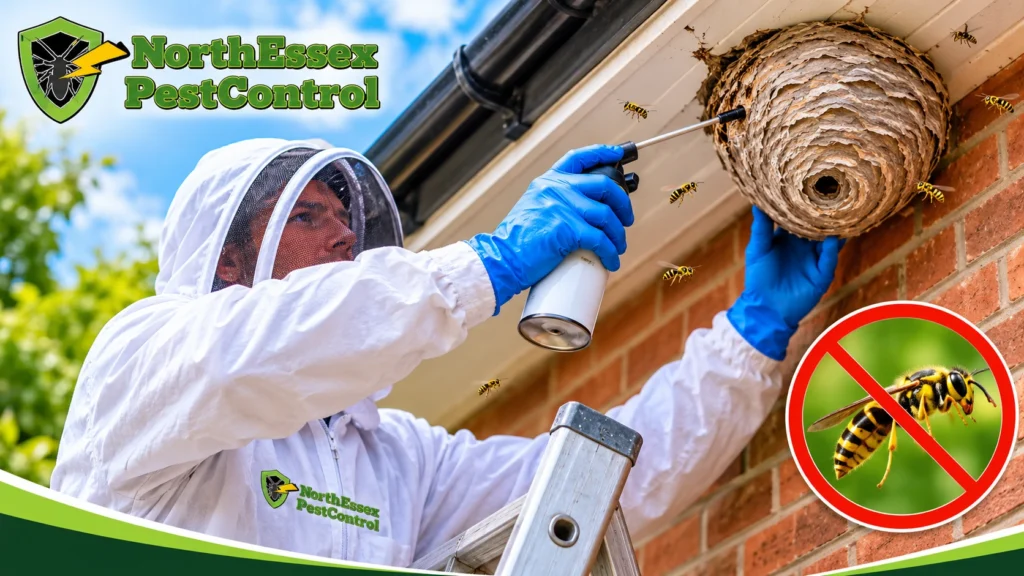
Not always. Treating a nest and taking it away are separate jobs, and the second is not automatically part of the first.
Once the colony is inactive, the paper shell can stay where it is. Old nests are not normally reused, though a good site can attract a new queen in a later season.
Removal makes sense when an accessible nest gets in the way of maintenance or repairs. Getting one out of an enclosed cavity is a bigger piece of work.

What to Expect After Treatment
Do not expect instant silence, even after treatment. Some wasps will still be flying for a while as the treatment takes effect, and developing wasps can emerge from protected cells afterwards.
Remaining wasps do not automatically mean the treatment failed. Follow the technician’s safety instructions, as professional treatment carries some risk too.
Tell them if substantial activity continues or if you suspect a second nest or an untreated access point.
Choosing a Provider for Wasp Nest Removal in Essex Properties Needed
People searching for wasp control in Colchester or Essex should find a long list of providers, so ask about training and insurance. Memberships such as NPTA or BASIS are worth asking about, but a logo alone does not prove an individual’s qualifications.
A good provider explains the method, the precautions for people and pets, and exactly what the price covers. Cost tends to reflect how difficult the nest is to reach.
At home, the usual trouble spots are lofts, rooflines, sheds, and children’s play areas. Pubs, offices, and schools may need treatment timed around customers and staff.
Get Professional Wasp Nest Assistance Across North Essex
At North Essex Pest Control, we handle domestic and commercial wasp problems, from wasp nest removal Colchester residents ask about to jobs in Tiptree, Lexden, Mersea, Marks Tey, Rowhedge, Fingringhoe, Peldon, Langenhoe, Fordham, Copford, Stanway, Wivenhoe, and West Mersea.
Details of our wasp removal & pest control services in North Essex and how to arrange an assessment are on our wasp pest control service page.
Frequently Asked Questions
How quickly can a wasp nest be treated?
That depends on our availability and how easy the nest is to reach. Mention any nest beside a doorway or play area when you call.
Do wasps return to an old nest?
They do not normally reuse it, because colonies die out each year. A good site can still attract a new queen the following season.
Does wasp nest treatment include physical removal?
Not automatically, as treating and removing are separate jobs. Ask about removal when you book.
Can wasps still appear after professional treatment?
Yes, for a while, as returning workers and emerging wasps may still be seen. If activity stays substantial, tell the technician.
Do you provide wasp nest removal in Colchester and surrounding Essex areas?
Yes, we cover Colchester and the North Essex communities listed above for homes and businesses. Any physical removal is agreed upon after assessment.